Samusa Thoke.
Burmese Samosa Salad
စမူဆာသုပ် · say it: sah-moo-sah TOKE
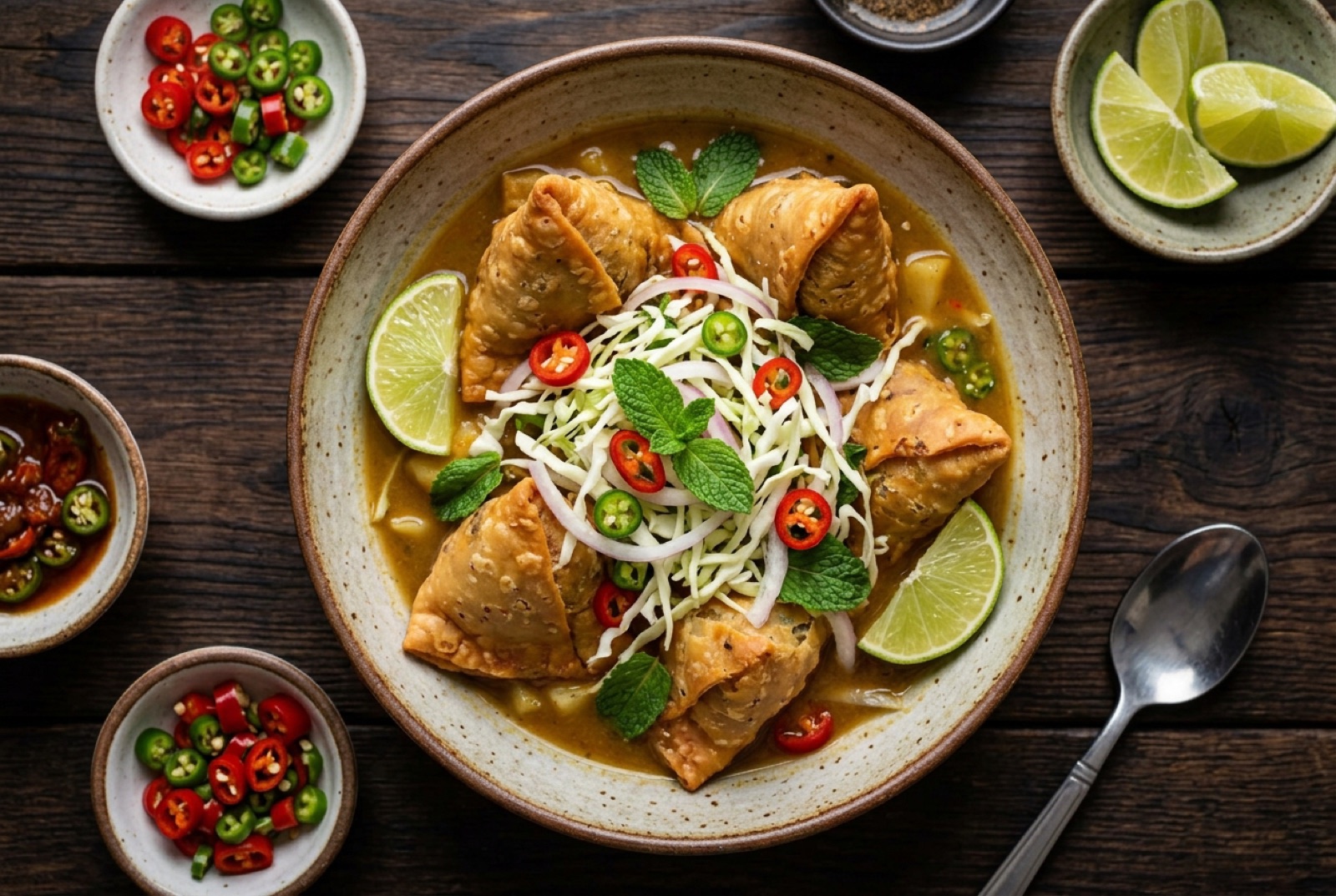
Samusa thoke is what happens when a samosa stops being finger food. Fried samosas are broken into rough pieces, a ladle of thin yellow potato-and-chickpea curry is poured over them, and the whole thing is tossed by hand with shredded cabbage, raw onion, mint, chile and lime. Some pastry stays crisp, some collapses into the sauce, and the contrast between the two is the entire appeal. It is sour, mildly spiced, and messier than any photograph makes it look. In Yangon it is street food sold from carts where the vendor assembles each bowl to order in about forty seconds, and it is one of the best examples of Burmese cooking's willingness to take something and simply mix it.

- Gate
- MyanmarYangon
- Prep
- 20 min
- Cook
- 30 min
- Total time
- 50 min
- Serves
- 4
- Status
- Easy
- Nutrition / serving · estimated
- Calories 520 kcal
- Protein 13 g
- Carbs 62 g
- Fat 25 g
- Fiber 9 g
- Sodium 830 mg
Why this recipe works.
- Gives a proper thin potato curry rather than telling you to pour gravy over pastry.
- Times the assembly so some pastry stays crisp and some softens, which is the whole point of the dish.
- Uses shop-bought or homemade samosas equally well, with instructions for re-crisping either.
- Balances the richness with enough raw onion, mint and lime that the bowl stays sharp instead of heavy.
Ingredients.
17 itemsFor the bowl
For the curry
To toss
Equipment
- Saucepan for the curry
- Oven or fryer to crisp the samosas
- Wide mixing bowl
Instructions.
Start the curry base
Heat the oil in a saucepan and cook the chopped onion over medium heat for 8 minutes, until soft, translucent and just beginning to take color at the edges. Add the garlic and cook one minute more, until it smells sweet rather than sharp.
Bloom the spices
Stir in the turmeric and curry powder and fry for 45 seconds, until the oil turns bright yellow and the spices smell toasted. Add the chickpea flour and stir hard for another 30 seconds so it coats the onions without lumping.
Simmer the potatoes
Add the diced potatoes, chickpeas and the water, season with salt, and simmer uncovered for 15–18 minutes, until the potatoes are soft enough to crush against the side of the pan and the liquid has taken on a faint body but is still clearly pourable.
Tip Crush a few potato pieces with the back of a spoon to thicken it slightly. It should stay thin like a light soup, not become a stew.
Season the curry hard
Taste and adjust — it needs to be noticeably salty and a little sour on its own, since the pastry will absorb and mute it. Add a squeeze of lime and keep it hot over the lowest heat.
Crisp the samosas
Heat the oven to 200°C and bake the samosas for 8–10 minutes, until the pastry is audibly crisp when tapped and blistered in places. Fry them instead if they are raw, until deep gold.
Tear and assemble
Tear the hot samosas into rough three-centimeter pieces straight into a wide bowl. Add the cabbage, drained raw onion, mint, cilantro, chile flakes and the remaining lime juice.
Douse and toss
Ladle over enough hot curry to wet everything without flooding the bowl — roughly two ladles for four servings — then toss quickly with your hands or two spoons for about ten seconds, just enough to coat while some pastry edges stay crisp.
Serve immediately
Divide into bowls and eat straight away, with lime wedges and extra chile on the table. This dish gets worse by the minute, so do not let it stand.
Tips from our kitchen.
- The curry must be thin — pourable like a light soup. A thick curry coats the pastry instead of soaking into it and the bowl turns pasty.
- Re-crisp shop-bought samosas in a hot oven for 8 minutes before breaking them. Room-temperature pastry goes limp the instant the curry hits it.
- Tear the samosas by hand into irregular pieces rather than cutting them. Ragged edges catch more sauce.
- Soak the sliced raw onion in cold water for 10 minutes to soften its harshness while keeping the crunch intact.
- Mix and serve within about thirty seconds. This dish has no shelf life once assembled and is not meant to sit.
- Taste the curry before it goes in; it should be a touch saltier and sourer than you would want it on its own, because the pastry mutes it.
Substitutions.
- Burmese samosas → Any small vegetable samosa, frozen or from an Indian shop
- Choose potato or lentil fillings over meat ones, and prefer thin-skinned samosas — thick pastry never softens properly in the sauce.
- Thin potato curry → Leftover chickpea or lentil curry thinned with water
- Vendors do exactly this. Just make sure to thin it well and check the salt after diluting.
- Fresh mint → Cilantro
- Cilantro is a fine stand-in but gives a softer, less cooling result; use a bit more of it than you would mint.
Variations.
- With split-pea crackers
- Fried yellow split peas or crisp lentil crackers scattered on top for a second crunch that survives the sauce longer than the pastry does.
- Extra sour
- Some carts add a spoonful of tamarind water alongside the lime, pushing the bowl markedly more sour — closer in balance to Indian chaat.
- Vegan samusa thoke
- Naturally meat-free if you use vegetable samosas and skip the fish sauce, seasoning the curry with salt and extra lime instead.
Storage & reheating.
The assembled bowl does not keep at all and should be eaten within minutes. The potato curry, however, refrigerates for 3 days and freezes for a month, so make it in advance and reheat it thin. Store samosas separately at room temperature for a day, or freeze them, and re-crisp in the oven right before assembling.
Serve with
Eaten on its own as a street snack, with extra lime wedges and a small dish of chile flakes on the side.
The story behind Samusa Thoke.
The samosa arrived in Myanmar the same way danbauk did, with the large Indian population that settled in Rangoon and other cities under British administration, and it stayed. Burmese samosas tend to be smaller and thinner-skinned than most Indian versions, often filled with spiced potato or lentils, and they are sold everywhere as a snack. What is distinctly Burmese is what happened next: at some point cart vendors began breaking them into bowls and dressing them, applying the thoke logic that Burmese cooks apply to everything from tea leaves to noodles to green mango.
The result sits in the same territory as Indian chaat — a crisp fried element deliberately softened by a wet one — and the family resemblance to something like samosa chaat is obvious and unsurprising given the shared history. But the seasoning goes a different way. There is no tamarind-date chutney, no yogurt, no chaat masala; instead you get a thin turmeric-yellow curry, raw onion, cabbage, mint and a heavy hand with lime, which makes the bowl sharper and less sweet than its Indian relative.
It is unapologetically improvised food. Vendors use whatever curry they have going, some add fried split-pea crackers for extra crunch, some throw in noodles, and the ratio of curry to pastry is decided by eye. Because it is assembled to order, the timing matters more than the recipe: the samosas need to be freshly fried or at least re-crisped, the curry needs to be hot and thin rather than thick, and the bowl needs to reach the table within a minute of mixing. Everything after that is a race against sogginess, which the Burmese solve by eating fast.
Questions, answered.
Why did my samosas turn to mush?
They were either not crisp enough to begin with or the bowl sat too long before eating. Re-crisp samosas in a hot oven right before assembling, mix everything at the last second, and serve immediately. Some softening is intended, but total collapse means the timing slipped.
How is this different from Indian samosa chaat?
The concept is closely related and the shared history is real — samosas came to Myanmar with Indian settlers during the colonial period. The difference is the dressing: samusa thoke uses a thin turmeric potato curry, raw onion, cabbage, mint and lime, with no yogurt, tamarind-date chutney or chaat masala, so it tastes sharper and less sweet.
Can I use frozen samosas?
Yes, and most home cooks outside Myanmar do. Bake or fry them from frozen according to the packet until deeply crisp, then use them straight away while hot. Thin-skinned vegetable samosas work far better than thick meat ones.
Is it eaten hot or cold?
Warm. The curry is hot, the samosas are hot from frying, and the raw vegetables are cool, so the bowl arrives at an in-between temperature. It is never served chilled and never reheated.
Can I make the curry ahead?
Yes, and it is the sensible way to do it. The potato curry improves overnight and reheats in minutes. Thin it with water when you reheat, since it thickens in the fridge, and only fry or crisp the samosas at serving time.
You might also like.
All recipes →
Keep exploring Myanmar.
Myanmar has 9 more dishes in the atlas — Balachaung and Danbauk, and 7 more.
All Myanmar recipes Potato recipes Chickpeas recipes Cabbage recipes street foodsnackdairy freevegetarianRecipe by The DishRoute Kitchen · published August 20, 2026 · updated August 20, 2026