Weißwurst with Sweet Mustard.
Bavarian White Sausage
Weißwurst mit süßem Senf · say it: VICE-voorst
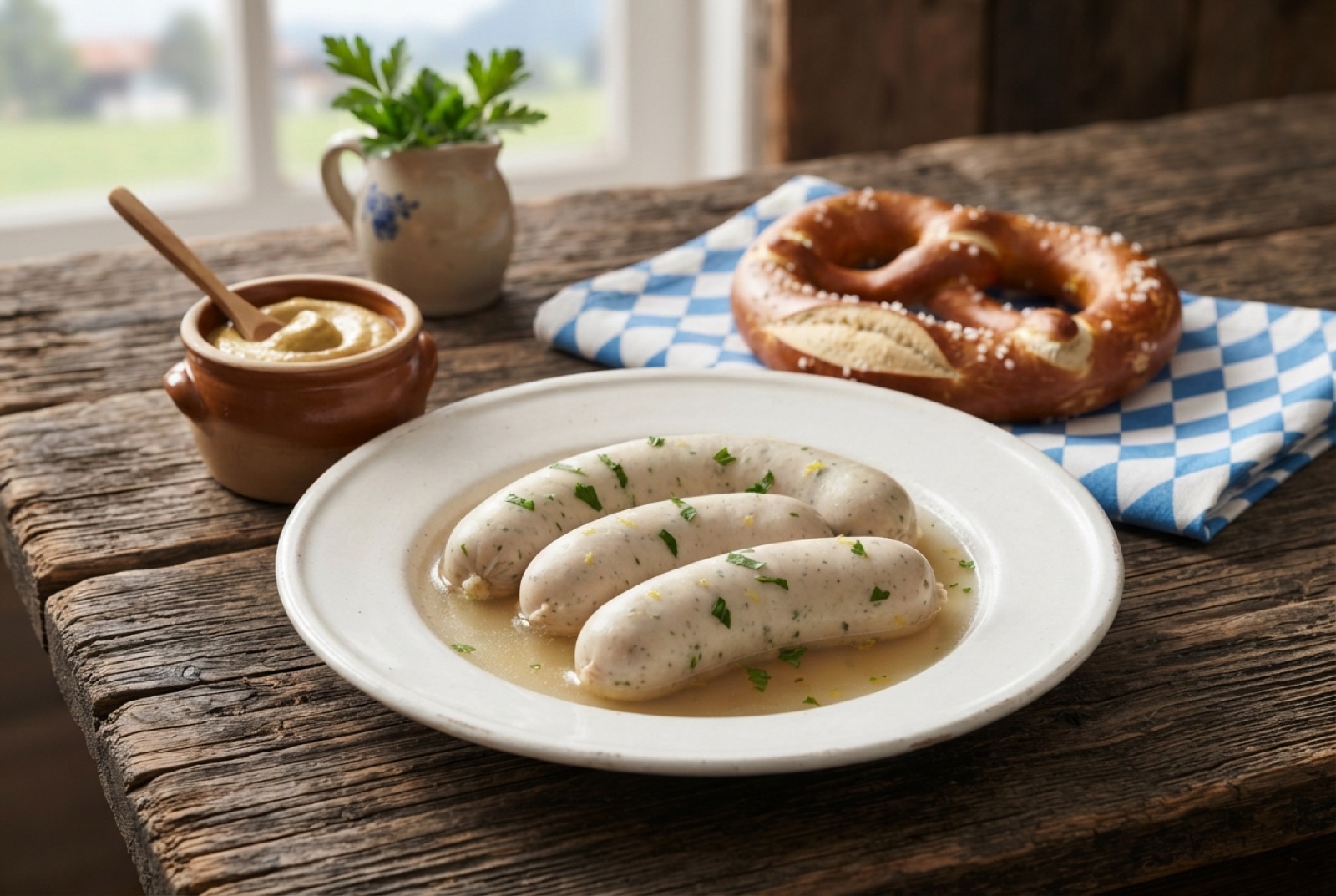
Weißwurst is a soft, pale sausage of finely minced veal and pork enriched with ice, seasoned with parsley, lemon zest, mace and white pepper, and poached gently in hot water rather than boiled or fried. The texture is the whole point: bouncy, fine-grained and almost custardy, closer to a French boudin blanc than to any grilling sausage. It is served floating in its poaching water in a covered tureen, eaten with sweet mustard, a Laugenbrezel and a wheat beer, and the skin is never eaten. This recipe makes the sausage from scratch and the sweet mustard alongside it, but poaching bought Weißwurst correctly is a legitimate half of the dish.

- Gate
- GermanyBavaria
- Prep
- 45 min
- Cook
- 15 min
- Total time
- 2 hr incl. 1 hr rest
- Serves
- 4
- Status
- Medium
- Nutrition / serving · estimated
- Calories 540 kcal
- Protein 42 g
- Carbs 18 g
- Fat 33 g
- Fiber 2 g
- Sugar 14 g
- Sodium 1480 mg
Why this recipe works.
- The forcemeat is emulsified with crushed ice and kept below 12°C, the one factor that decides whether the sausage is springy or grainy.
- Sweet Bavarian mustard made from scratch in ten minutes, because the bought version is hard to find outside Germany.
- Poaching temperature given as a number, not "simmer" — the casings split above 80°C and there is no repairing them.
- Honest about the shortcut: buying good Weißwurst and only poaching it gets you most of the way there.
Ingredients.
18 itemsFor the sausage
For the sweet mustard
Equipment
- Food processor or meat grinder with a fine plate
- Sausage stuffer or piping bag
- Digital thermometer
- Wide pot
Instructions.
Make the sweet mustard first
Toast the mustard seeds in a dry pan for 2 minutes until they start to pop, then grind about two-thirds of them coarsely and leave the rest whole. Melt the brown sugar in a small pan until it darkens slightly, add the vinegar, water, salt and cloves, and simmer 3 minutes.
Finish and rest the mustard
Stir the ground and whole mustard seeds into the warm syrup, take it off the heat and let it stand at least an hour so the seeds swell and soften. It thickens as it sits; loosen it with a spoon of water if it sets too stiff.
Tip Mustard tastes harshly bitter for the first hour and mellows considerably overnight. Make it a day ahead if you can.
Chill everything
Put the cubed veal, the minced pork, the processor bowl and the blade in the freezer for 20 minutes. The forcemeat must stay below 12°C throughout, or the fat and meat separate and the cooked sausage turns crumbly.
Blend the forcemeat
Blitz the veal with the salt and spices to a fine paste, then add the pork and blend again. With the machine running, add the crushed ice in three batches until the mixture is pale, glossy and smooth like thick whipped butter. Pulse in the parsley, grated onion and lemon zest last so the parsley stays visible as green flecks.
Tip Stop and feel the mixture. If it is not distinctly cold to the touch, put the whole bowl back in the freezer for 10 minutes before continuing.
Stuff the casings
Slide a soaked casing onto the stuffer nozzle and fill it loosely, keeping the forcemeat free of air pockets. Twist into sausages about 12 cm long and 4 cm thick, alternating direction each time so they do not unwind. Prick any visible air bubbles with a fine needle.
Poach gently
Bring a wide pot of water to 80°C — steam rising, no bubbles breaking the surface — and slide in the sausages. Hold the temperature between 75 and 80°C for 12 to 15 minutes, until a sausage feels firm and springs back when pressed and floats high in the water.
Tip Use a thermometer and add a splash of cold water if the pot creeps towards a simmer. Boiling water splits the casings within seconds.
Serve in the water
Carry the sausages to the table in a bowl with enough of their hot poaching water to cover them, lid on. Serve two per person with a generous spoon of sweet mustard, a fresh pretzel and wheat beer, peeling the skin off each sausage before eating.
Tips from our kitchen.
- Keep everything cold. Chill the meat, the bowl and the blade in the freezer for 20 minutes first; a forcemeat that warms past about 12°C breaks and the cooked sausage turns crumbly and weeps fat.
- Add the crushed ice in stages while blending. It both cools the mixture and supplies the water that makes the texture bouncy rather than dry.
- Soak natural hog casings in cold water for at least 30 minutes and rinse them through, inside and out, before stuffing.
- Do not overfill the casings. Weißwurst expands during poaching, and a tightly packed sausage splits and leaks its filling into the pot.
- Poach at 75 to 80°C — steam rising, no bubbles breaking the surface. Actual simmering bursts the delicate skins within a minute.
- Serve them in the water they cooked in, in a covered dish. Drained and plated, they cool and stiffen within a couple of minutes.
Substitutions.
- Homemade sausage → 8 good-quality bought Weißwurst
- Entirely legitimate. Skip to the poaching step and make just the mustard. German butchers and delis sell them fresh or vacuum-packed.
- Veal → Lean pork shoulder, or a mix of pork and turkey breast
- The sausage will be a little less delicate and slightly darker, but the seasoning carries it. Traditional Weißwurst is legally required to be mostly veal in Germany.
- Natural hog casings → Cling film, rolled and twisted into 12 cm cylinders
- Roll the forcemeat tightly in film, twist the ends hard and poach as normal. Not traditional, but it gives you the correct texture with no casing equipment.
- Ground mace → Ground nutmeg, used slightly more sparingly
- Mace is the outer layer of the same seed and is milder and more floral. Nutmeg is close enough that most people would not identify the swap.
Variations.
- Bought and poached
- The everyday Bavarian reality. Buy fresh Weißwurst from a butcher, poach them at 75°C for 10 minutes and put all the effort into the mustard and the pretzel instead.
- Weißwurst with horseradish
- A minority Bavarian habit: freshly grated horseradish alongside the sweet mustard, which cuts the richness sharply. Frowned upon by purists, enjoyed anyway.
- Grilled Weißwurst
- Split lengthways and grilled cut-side down until the surface browns. Not traditional and mildly scandalous in Munich, but it is what many Bavarians do with the leftovers.
Storage & reheating.
Fresh Weißwurst is highly perishable because it contains no curing salt: poach it the day it is made, and refrigerate uncooked sausage for no more than 24 hours. Cooked sausages keep 2 days refrigerated and are reheated in 75°C water for 5 minutes, never in a microwave, which turns them rubbery. Raw sausages freeze for 2 months; poach from frozen with 5 extra minutes. The sweet mustard is the durable part — it keeps 3 months refrigerated in a sealed jar and its flavour rounds out after a week.
Serve with
Sweet Bavarian mustard, a fresh Laugenbrezel and a cold wheat beer — the complete Weißwurstfrühstück.
The story behind Weißwurst with Sweet Mustard.
Munich tells a specific story about this sausage: on a February morning in 1857, an innkeeper at the Gasthaus zum Ewigen Licht on Marienplatz ran out of sheep casings, used pig casings instead, and poached the sausages rather than grilling them because the thicker casing would have burst over fire. The tale is repeated on menus across Bavaria and nobody can verify the details, but the technical logic behind it is real — the casing is too fragile for heat, which is exactly why Weißwurst is poached and why the skin is stripped off at the table.
The famous rule is that a Weißwurst should not hear the noon bell. That comes from a time before refrigeration, when the sausage contained no curing salts or preservatives and was made in the small hours to be eaten the same morning; anything left by midday was no longer safe. Refrigeration removed the danger and Bavarians kept the rule anyway, because it defines an occasion rather than a food safety measure. Weißwurstfrühstück is a mid-morning institution — sausage, sweet mustard, pretzel, Weißbier — and ordering it at dinner marks you as an outsider more reliably than an accent does.
Eating it has its own etiquette. The traditional method is zuzeln: pick up the sausage, bite one end and suck the filling out of the casing, which is done confidently in beer halls and disastrously by tourists. The polite alternative is to slit the sausage lengthways with a knife and roll the meat out of its skin, or halve it crossways and peel each half. What is not negotiable is the mustard. Süßer Senf, a coarse sweet mustard darkened with caramelised sugar, is the only correct partner; a sharp mustard flattens the delicate seasoning the sausage is built around.
Questions, answered.
Why should Weißwurst not be eaten after noon?
The rule dates from before refrigeration, when the sausage was made without preservatives in the early morning and would not stay safe past midday. Refrigeration removed the risk long ago, but Bavarians kept the custom because it marks Weißwurst as a mid-morning meal. Nothing bad happens if you eat it at one o'clock apart from mild social judgement.
Do you eat the skin of a Weißwurst?
No. The casing is left on the plate. Either bite one end and suck out the filling, the traditional method called zuzeln, or slit the sausage lengthways with a knife and roll the meat out of the skin. Cutting it into rounds and eating skin and all is the clearest sign you are not from Munich.
Why did my sausages burst while cooking?
The water was too hot, or the casings were overstuffed. Weißwurst must be held at 75 to 80°C, with steam rising and no bubbles breaking the surface; a true simmer splits the delicate skins almost immediately. Filling casings loosely leaves room for the expansion that happens as they heat.
What makes Weißwurst white?
It contains no curing salt, which is what gives most sausages their pink colour, and it is poached rather than browned. The pale colour comes from veal, pork fat and a high proportion of ice worked into the forcemeat. That absence of curing salt is also why it spoils quickly and has to be eaten fresh.
Can I use ordinary mustard instead of sweet mustard?
You can, but it changes the dish. Weißwurst is seasoned delicately with parsley, lemon and mace, and a sharp Dijon or hot English mustard simply overrides it. Bavarian süßer Senf is coarse, dark and sweetened, and it complements rather than competes. The homemade version here takes ten minutes.
You might also like.
All recipes →
Keep exploring Germany.
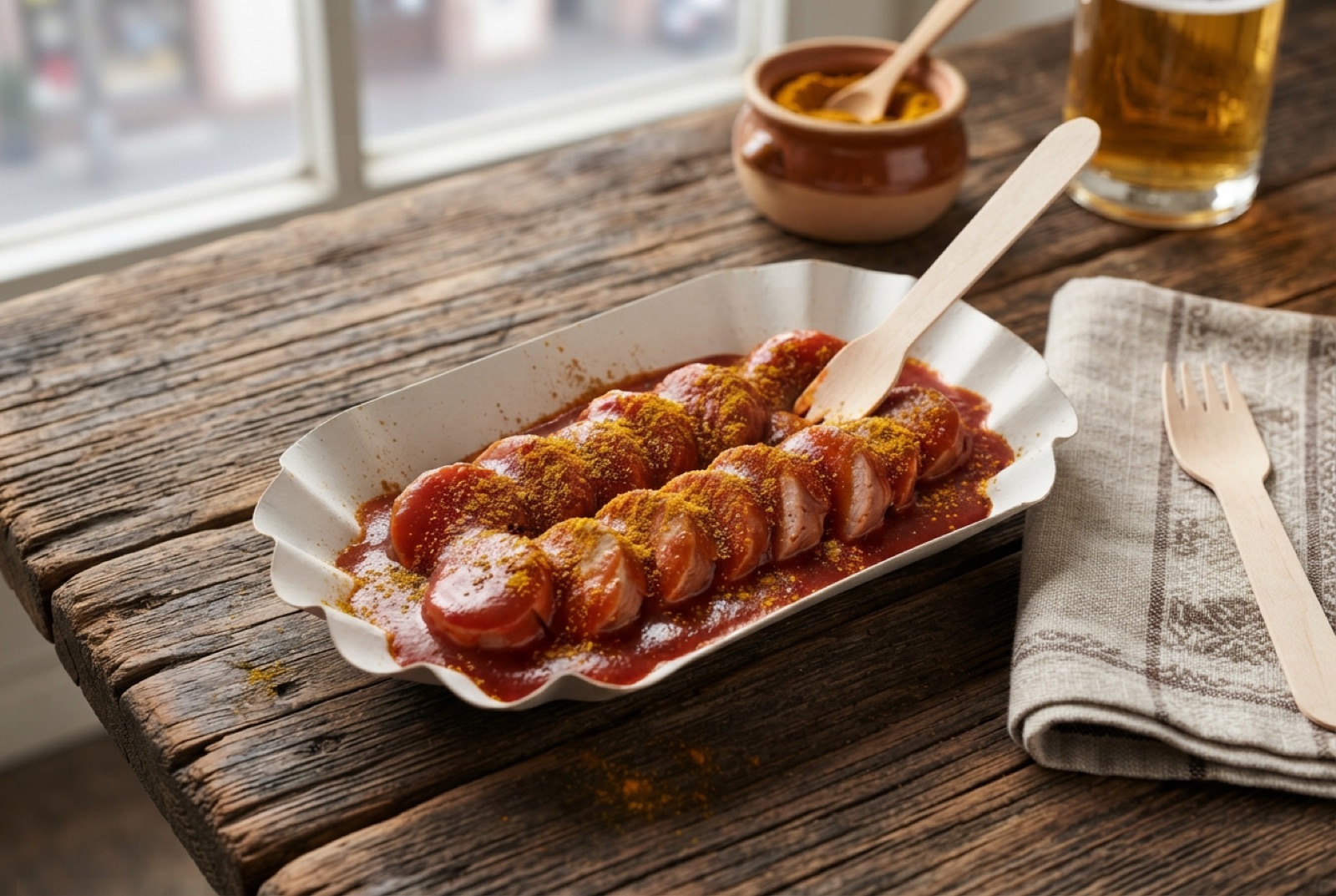
Germany has 9 more dishes in the atlas — Currywurst and Handkäse mit Musik, and 7 more.
Recipe by The DishRoute Kitchen · published August 19, 2026 · updated August 19, 2026