Pannenkoeken.
Large Thin Dutch Pancakes
Pannenkoeken · say it: PAH-nen-koo-ken
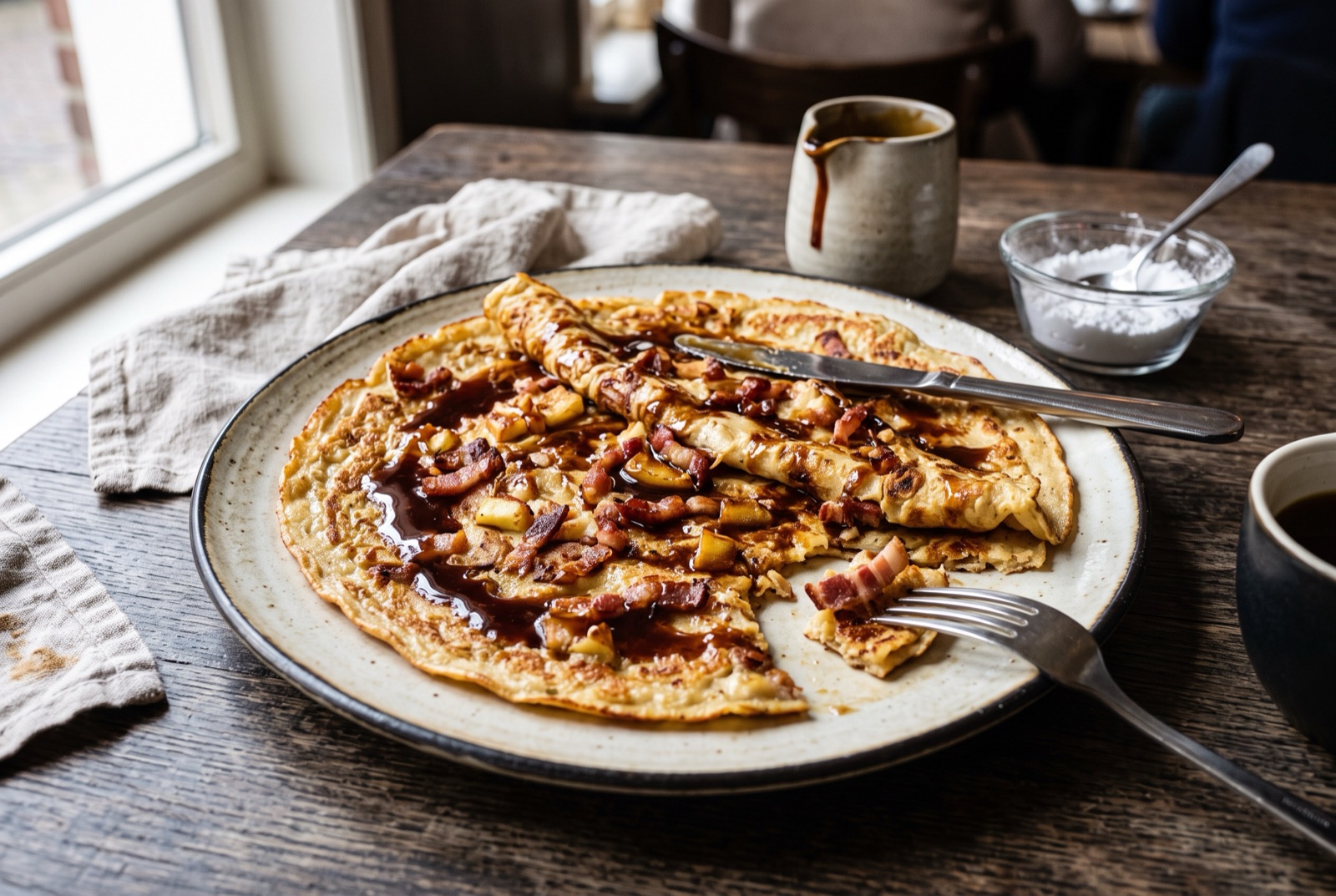
A pannenkoek is the size of the pan it is cooked in — usually 26 to 30 centimetres — and lands somewhere between a crêpe and a pancake: thin, but with enough body to hold a layer of bacon or sliced apple that is laid into the pan and cooked into the batter rather than added afterwards. The batter is plain, just flour, eggs, milk and salt, because the point is the topping. Sweet and savoury are not separate categories here: the classic order is spek en appel, bacon and apple in the same pancake, finished with stroop, a thick dark syrup that is poured across the whole thing at the table.

- Gate
- Netherlands
- Prep
- 15 min
- Cook
- 25 min
- Total time
- 1 hr 10 min incl. 30 min rest
- Serves
- 4
- Status
- Easy
- Nutrition / serving · estimated
- Calories 560 kcal
- Protein 20 g
- Carbs 62 g
- Fat 25 g
- Fiber 3 g
- Sugar 18 g
Why this recipe works.
- Rests the batter, which is what stops the pancakes tearing and gives them their tender, slightly stretchy texture.
- Cooks bacon and apple into the batter the way a Dutch pancake house does, rather than folding them in afterwards.
- Gives a batter ratio that produces a real pannenkoek — thinner than a fluffy stack, sturdier than a crêpe.
- Includes the pan and heat detail that decides whether pancake number one is edible or a sacrifice.
Ingredients.
10 itemsFor the batter
For the toppings
To serve
Equipment
- 26–30 cm frying pan or crêpe pan
- Whisk
- Wide flat spatula
- Ladle
Instructions.
Mix the batter
Whisk the flour and salt with the eggs and about a third of the milk to a smooth, thick paste with no lumps, then thin it with the remaining milk and the melted butter. It should be the consistency of single cream and coat a spoon thinly.
Tip Starting thick is the trick — lumps break up easily in a stiff paste and are almost impossible to whisk out of a thin one.
Rest it
Cover the bowl and leave the batter at room temperature for 30 minutes, or overnight in the fridge. It will thicken slightly as the flour hydrates; loosen with a splash of milk before cooking if needed.
Fry the bacon into the pan
Heat the pan over medium heat and lay in two or three rashers of bacon, spread out. Cook for 2 minutes a side, until the fat has rendered and the edges are just starting to crisp, then pour off all but a film of the fat.
Pour and swirl
Ladle in enough batter to cover the base — about 100 ml for a 28 cm pan — and immediately tilt and rotate the pan so it flows to the edges in an even layer around the bacon. Lay apple rings on top while the surface is still wet.
Cook the first side
Cook for 2–3 minutes, until the top has turned matte with no wet gloss left, the edges have lifted away from the pan and the underside is patched golden brown when you peek beneath it with a spatula.
Turn and finish
Slide the spatula fully under the pancake and flip in one movement. Cook the second side for 1–2 minutes, pressing the apple rings gently against the pan so they caramelise, then slide it onto a warm plate.
Repeat and keep warm
Wipe the pan, add a scrape of butter and repeat with the remaining batter, stacking the pancakes on a covered plate set over a pan of simmering water. The batter makes about eight pancakes.
Serve with stroop
Bring the stack to the table whole with the pot of stroop, the cinnamon sugar and icing sugar beside it, and let everyone pour their own. Eat with a knife and fork, folded or rolled.
Tips from our kitchen.
- Rest the batter at least 30 minutes. It lets the flour hydrate and the gluten relax, which makes the pancakes tender instead of rubbery.
- Aim for batter the consistency of single cream. Too thick and it will not spread to the pan edges; too thin and it tears when you turn it.
- Use a proper large pan, 26–30 cm, and get it evenly hot before the first pancake. The first one is always the worst — cook it, eat it standing up, move on.
- Barely grease the pan between pancakes. Pooled butter fries the surface into a lacy, greasy mess instead of an even golden face.
- Turn only when the top has set to matte and the edges lift away from the pan cleanly. Flipping early is why pancakes tear.
- Stack the finished pancakes on a plate over a pan of simmering water with a lid — they stay hot and stay soft, and nothing goes soggy.
Substitutions.
- Stroop (Dutch syrup) → Dark treacle thinned with a little golden syrup, or molasses
- Real stroop is thick, dark and less sweet than maple syrup. Maple works but tastes noticeably different and much sweeter; treacle is closer.
- Whole milk → Half milk and half sparkling water, or any plant milk
- Sparkling water gives a slightly lighter pancake. Plant milks work fine; oat milk browns fastest, so drop the heat a little.
- Bacon → Sliced mushrooms fried in butter, or grated aged Gouda
- Both are standard pancake house options. Fry mushrooms first and pour off their liquid, or the batter will not set around them.
Variations.
- Spek en appel
- The classic double act: bacon fried into the base, apple rings laid on top, syrup poured over everything at the table.
- Pannenkoek met kaas en ui
- Grated aged Gouda and thin onion rings cooked into the batter — savoury, and better with mustard than with syrup.
- Poffertjes
- The market version: tiny puffed yeasted pancakes made in a dimpled pan, served with a slab of butter and a snowdrift of icing sugar.
Storage & reheating.
Cooked pancakes keep 2 days refrigerated, stacked with baking paper between them and wrapped so they do not dry out. Reheat in a dry pan for about 30 seconds a side — the microwave makes them limp and rubbery. They freeze for 2 months interleaved with paper. Raw batter keeps 24 hours in the fridge and actually improves; whisk it briefly before use, as the flour settles to the bottom.
Serve with
A pot of stroop on the table, plus icing sugar and butter for anyone who wants a sweet one.
The story behind Pannenkoeken.
Pannenkoeken are dinner in the Netherlands, not breakfast. Pannenkoekenhuizen — pancake houses, often in converted farmhouses or beside playgrounds and woodland car parks — are a whole category of Dutch restaurant, with menus running to forty or more numbered combinations and portions that arrive hanging off the plate. They are where families take children on a Sunday, and where a pancake with bacon and syrup is a perfectly normal main course for an adult.
The habit of cooking the filling into the batter is what distinguishes them from crêpes. Slices of streaky bacon are fried in the pan first and the batter poured over them so they set into the surface; apple rings are laid into the wet batter and lightly caramelise on the underside. Cheese, ginger, raisins, mushrooms and, in the Amsterdam pancake houses, entire Indonesian-influenced combinations all appear on the same menu without anyone treating the mix as unusual.
Stroop is the other fixed element. Dutch stroop is a thick, dark, only moderately sweet syrup made from sugar beet or from apples and pears, closer to molasses than to maple syrup, and it comes to the table in a tall pot with a lid. It is poured over savoury pancakes as readily as sweet ones. The smaller cousins are separate dishes with their own gear: poffertjes, coin-sized puffed pancakes made in a dimpled cast-iron plate and served under a mound of butter and icing sugar, are a fairground and market food rather than something made at home.
Questions, answered.
What is the difference between a pannenkoek and a crêpe?
A pannenkoek is thicker and sturdier. Crêpe batter is thinner and often includes more egg and melted butter, producing a lacy, delicate pancake; Dutch batter is plainer and slightly heavier, which is what allows bacon or apple slices to be cooked into it without tearing. Pannenkoeken are also bigger, filling the whole pan, and are eaten as a main meal rather than a dessert.
Why does my first pancake always fail?
Because the pan is not yet at an even temperature and usually holds too much fat. This is normal in every pancake tradition, and the fix is to accept it: cook the first one, discard or eat it, and wipe the pan with kitchen paper so only a film of fat remains. From the second onward the pan is seasoned and evenly hot and the results are consistent.
Do I have to rest the batter?
You should. Thirty minutes lets the flour absorb the liquid fully and the gluten relax, which gives a more tender pancake that spreads evenly and tears less. Unrested batter cooks up slightly rubbery and often has a faintly raw flour taste. If you are in a hurry, fifteen minutes helps noticeably; overnight in the fridge is even better.
Sweet or savoury — which is correct?
Both, often on the same pancake. The Dutch see no conflict in eating bacon, apple and dark syrup together, and pancake house menus mix cheese, ginger, mushrooms, raisins and syrup freely. If you find the combination odd, cook the bacon version and serve it with mustard instead — nobody will object, though it is less traditional.
Can I make the batter ahead?
Yes — an overnight rest visibly improves the batter. Mix it the night before, cover and refrigerate it — the flour hydrates fully and the pancakes come out more tender. It thickens slightly overnight and separates, so whisk it and add a splash of milk to bring it back to the consistency of single cream before you start cooking.
You might also like.
All recipes →
Keep exploring Netherlands.
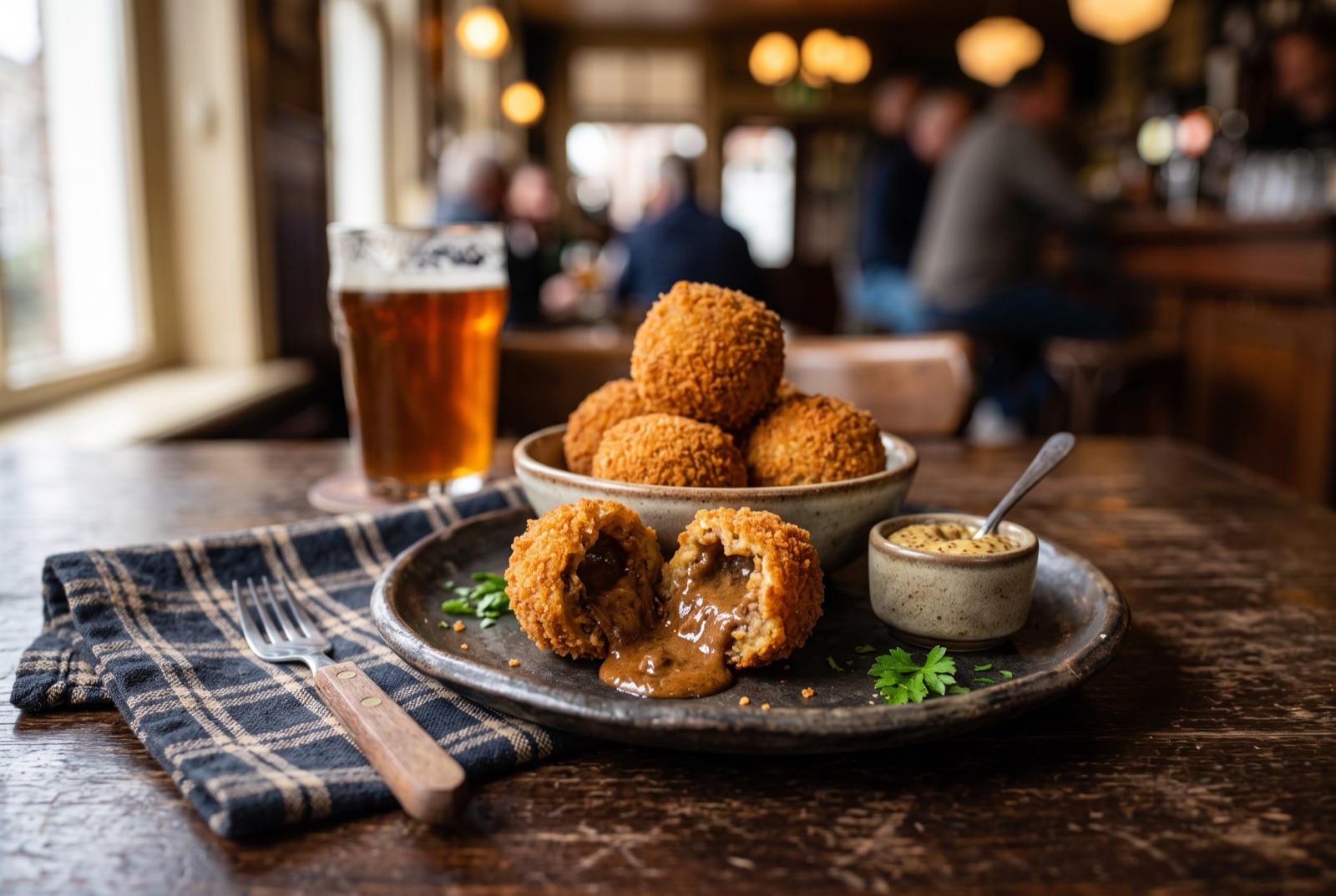
Netherlands has 9 more dishes in the atlas — Bitterballen and Draadjesvlees, and 7 more.
Recipe by The DishRoute Kitchen · published August 19, 2026 · updated August 19, 2026