Hachee.
Dutch Onion and Beef Stew with Vinegar
Hachee · say it: hah-SHAY
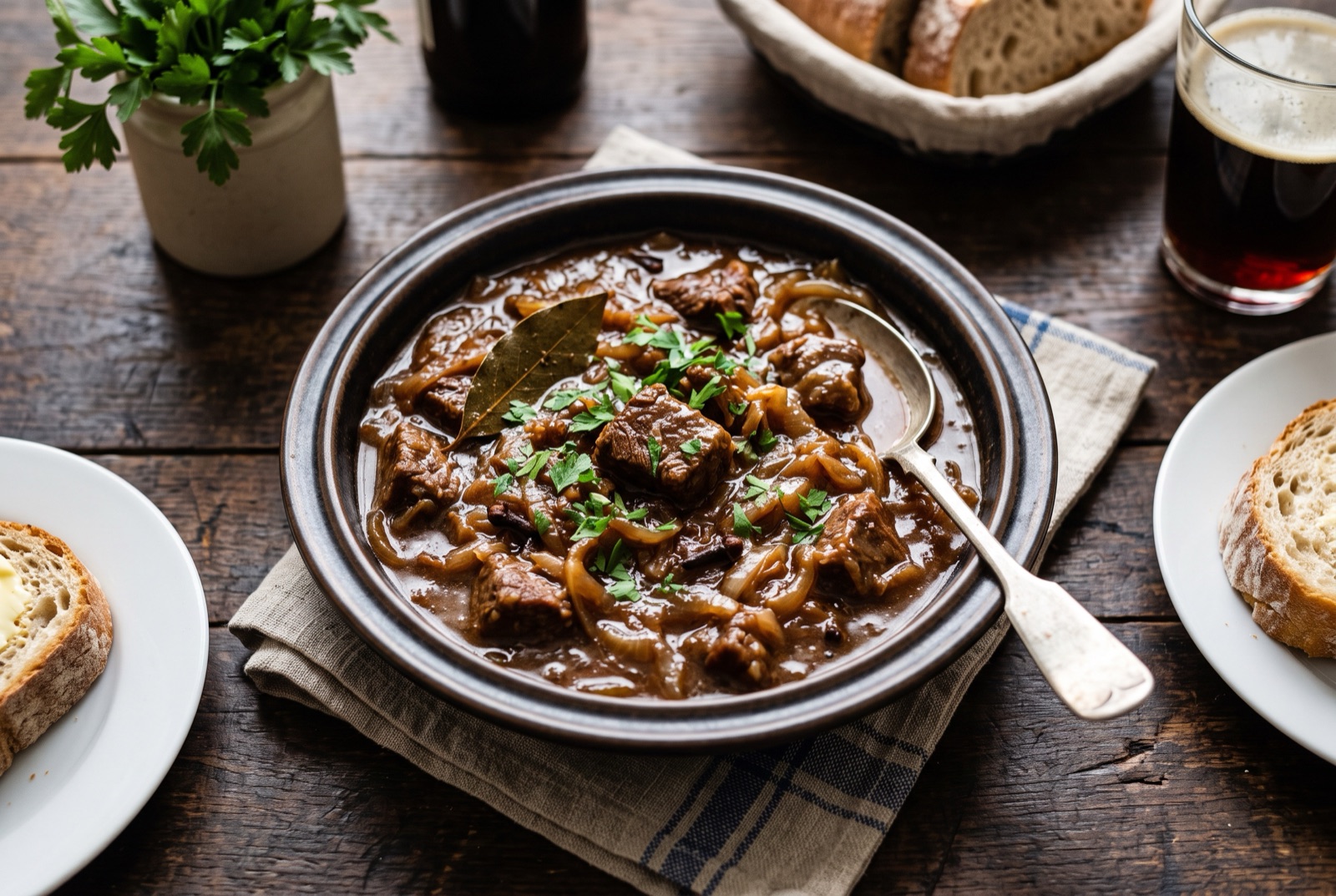
Hachee is a stew where the onion is the co-star, not the background. Equal weights of onion and stewing beef go into the pot with bay, whole cloves and a decent splash of vinegar, and after two hours the onions have collapsed entirely into a thick, dark, faintly sweet-sour sauce with tender cubes of beef suspended in it. There is no wine, no cream and no tomato — the flavour is built from browned onion, spice and acid. It is eaten with boiled potatoes and braised red cabbage, in that specific combination, in Dutch homes throughout the winter, and it is one of the few old Dutch dishes that also works perfectly well as a way to use up yesterday's roast.

- Gate
- Netherlands
- Prep
- 25 min
- Cook
- 2 hr 20 min
- Total time
- 2 hr 45 min
- Serves
- 4
- Status
- Medium
- Nutrition / serving · estimated
- Calories 520 kcal
- Protein 42 g
- Carbs 23 g
- Fat 28 g
- Fiber 4 g
- Sugar 12 g
Why this recipe works.
- Uses a genuine one-to-one onion-to-beef ratio, which is what separates hachee from any other brown stew.
- Browns the onions properly first, so the sauce is dark and sweet rather than pale and raw-tasting.
- Times the vinegar in two stages — early for depth, a final splash for lift — instead of dumping it all in at once.
- Gives a leftover-meat version too, which is how the dish was originally made and still is in many households.
Ingredients.
12 itemsFor the stew
Equipment
- Heavy lidded casserole or Dutch oven
- Sharp knife
- Wooden spoon
Instructions.
Brown the beef
Dry the beef cubes thoroughly and season with salt. Melt half the butter in a heavy casserole over medium-high heat and brown the meat in two batches until each cube is well coloured, about 5 minutes a batch. Set aside.
Brown the onions properly
Add the remaining butter and all the sliced onion to the pot with a pinch of salt. Cook over medium heat for 15 minutes, stirring often, until the volume has collapsed by two-thirds and the strands are deep gold with brown edges and smell sweet rather than sharp.
Tip The onions will first release water and look soupy. Keep going past that stage — the browning only starts once the liquid has cooked off.
Add flour and spices
Sprinkle the flour over the onions and stir for a full minute until it smells toasted, not raw. Add the bay, cloves, peppercorns and 2 tablespoons of the vinegar, scraping the base of the pot as the vinegar steams and lifts the brown crust.
Simmer long and low
Return the beef with its juices, pour in the hot stock and stir in the appelstroop and mustard. Bring to a bare simmer, cover with the lid ajar and cook on the lowest heat for 2 hours, stirring every 30 minutes.
Check the texture
The stew is ready when the onions have disappeared into a thick brown sauce and a cube of beef gives way completely under gentle pressure from a spoon. If the meat is still firm, simmer another 20–30 minutes and check again.
Tip If the sauce is looser than you want, mash a spoonful of the soft onions against the side of the pot and stir it back in.
Finish with acid
Remove the bay leaves and cloves. Stir in the last tablespoon of vinegar off the heat, then taste and adjust with salt, pepper and a little more sugar or vinegar until savoury, sweet and sour sit in balance.
Serve
Rest the pot off the heat for 10 minutes so the sauce settles and thickens slightly, then serve with boiled potatoes and braised red cabbage, spooning the sauce over the potatoes.
Tips from our kitchen.
- Weigh the onions. It sounds like too many; it is not. Under-onioned hachee is just beef stew, and the onions cook down to a fraction of their raw volume.
- Slice the onions rather than dicing them — long strands melt into the sauce, while dice tend to survive as recognisable cubes.
- Take the onions past golden to properly brown at the edges. This is the single biggest flavour decision in the dish and it takes a full 15 minutes.
- Cut the beef into small cubes, around 2–3 cm. Hachee is meant to be eaten with a spoon alongside potatoes, not carved.
- Taste for acid at the end, not the beginning. Long cooking mellows vinegar dramatically, so the final splash is what you actually taste.
- If the sauce needs thickening, mash a few of the soft onions against the side of the pot rather than adding flour.
Substitutions.
- Red wine vinegar → Apple cider vinegar, or half vinegar and half dark beer
- Cider vinegar is slightly softer and works well with the clove. Beer pushes the stew towards its Flemish cousin, which is a legitimate direction.
- Ontbijtkoek or appelstroop → 1 tbsp dark brown sugar, or a tablespoon of apple butter
- Both are there to round off the vinegar and add body. Gingerbread also brings clove and cinnamon, so if you use sugar instead, add an extra pinch of ground clove.
- Raw stewing beef → 600 g leftover roast beef or braised meat, cut small
- The original method. Cook the onions and sauce for an hour first, then add the cooked meat for the last 20 minutes only — longer and it turns dry and stringy.
Variations.
- Hachee van kliekjes
- The leftovers version: chopped cooked roast, added to a finished onion sauce for the last twenty minutes. Faster, and closer to the dish's origins.
- Hachee with juniper
- Four or five crushed juniper berries added with the bay give a resinous, gin-like note — a nod to jenever, the Dutch spirit distilled with the same berry.
- Mushroom hachee
- A vegetarian take built on 600 g of mixed mushrooms browned hard in butter, using vegetable stock and a little soy sauce for depth in place of the beef.
Storage & reheating.
Hachee keeps 4 days refrigerated and genuinely tastes better on day two, once the vinegar has settled into the onions. Reheat covered over low heat, adding a splash of water if the sauce has tightened. It freezes for 3 months without any loss of texture, since there is no dairy or flour to split. Add the finishing splash of vinegar after reheating rather than before freezing, so the brightness is not lost.
Serve with
Boiled potatoes and braised red cabbage with apple — the fixed Dutch trio. Pickled gherkins on the side.
The story behind Hachee.
The name comes from the French hacher, to chop, and hachee began as a thrift dish: leftover cooked meat chopped fine and stewed with onions until it became something new. That origin still shows in the traditional method, where the meat is cut small rather than left in large chunks, and in the fact that plenty of Dutch families make hachee specifically from Sunday's leftover beef rather than from raw meat. The version with raw stewing beef, cooked long enough to become tender in its own right, is now more common and is what most recipes give.
The seasoning is the signature. Bay and clove appear together in a way that would look odd in French or Italian cooking but is completely standard in Dutch pots, and the vinegar at the end is not optional — hachee without it is a flat brown stew. Some cooks use appelstroop or a slice of ontbijtkoek, the spiced Dutch breakfast cake, to thicken and round the sauce, which is the same trick used in Limburg zuurvlees and Flemish stoofvlees. All three are relatives, and the boundaries between them are argued over rather than defined.
What has not changed in a century is what goes on the plate beside it. Hachee, boiled potatoes and rodekool met appeltjes — red cabbage braised with apple, sugar and vinegar — is one of the fixed trios of Dutch cooking, the sort of combination that appears on hospital menus and in canteen rotations without anyone questioning it. The cabbage matters more than it sounds: its sweetness and acidity mirror the stew's, and the plate loses its balance without something sharp next to all that soft onion.
Questions, answered.
Why does hachee use so many onions?
The onions are the thickener and the main flavour, not a supporting aromatic. Cooked for two hours they break down completely, giving the stew its body and its sweetness without any flour or cream. A one-to-one weight ratio with the beef looks excessive when raw but reduces to roughly a quarter of its volume, so cutting back leaves you with a thin, ordinary beef stew.
My hachee tastes too sour — can I fix it?
Yes. Stir in a teaspoon of brown sugar, appelstroop or apple butter and let it cook for another five minutes, then taste again. A knob of butter also rounds sharp acidity. Vinegar mellows with time, so a stew that tastes aggressive straight off the stove often settles by the next day.
What cut of beef should I use?
A collagen-rich braising cut: chuck, shin, brisket point or blade. These need long cooking but turn tender and give the sauce its body. Avoid lean cuts such as topside, silverside or steak trimmings, which stay dry and chewy no matter how long they simmer. Cut whatever you use into small 2–3 cm cubes.
How is hachee different from draadjesvlees?
Hachee has roughly equal onion and meat, cooked until the onions melt into a thick sauce while the beef stays in distinct cubes. Draadjesvlees is mostly meat, cooked much longer, until it shreds into threads in a thinner, glossier sauce. They share the bay-clove-vinegar seasoning, which is why they are often confused, but they behave differently on the plate.
Can I make hachee in advance for a dinner?
It is one of the best make-ahead stews there is. Cook it fully a day or two before, cool and refrigerate, then reheat gently on the hob for 20 minutes. Add the final splash of vinegar and check the seasoning after reheating. The red cabbage that traditionally goes with it also improves overnight, so both parts of the meal can be done in advance.
You might also like.
All recipes →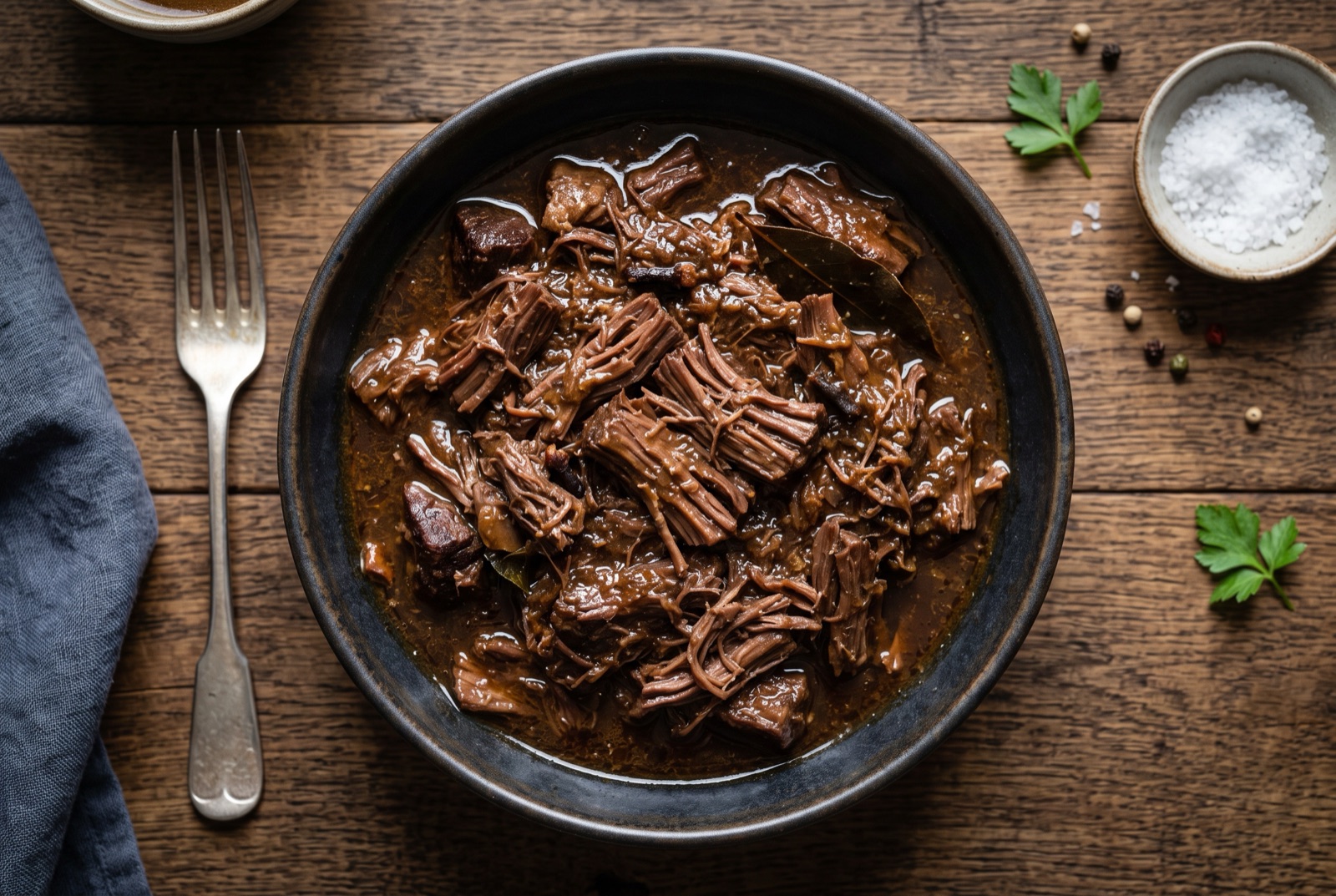
Keep exploring Netherlands.
Netherlands has 9 more dishes in the atlas — Bitterballen and Draadjesvlees, and 7 more.
Recipe by The DishRoute Kitchen · published August 19, 2026 · updated August 19, 2026