Hollandse Nieuwe.
Dutch Cured Herring with Raw Onion
Hollandse Nieuwe haring met uitjes · say it: HOL-and-suh NEE-wuh HAH-ring
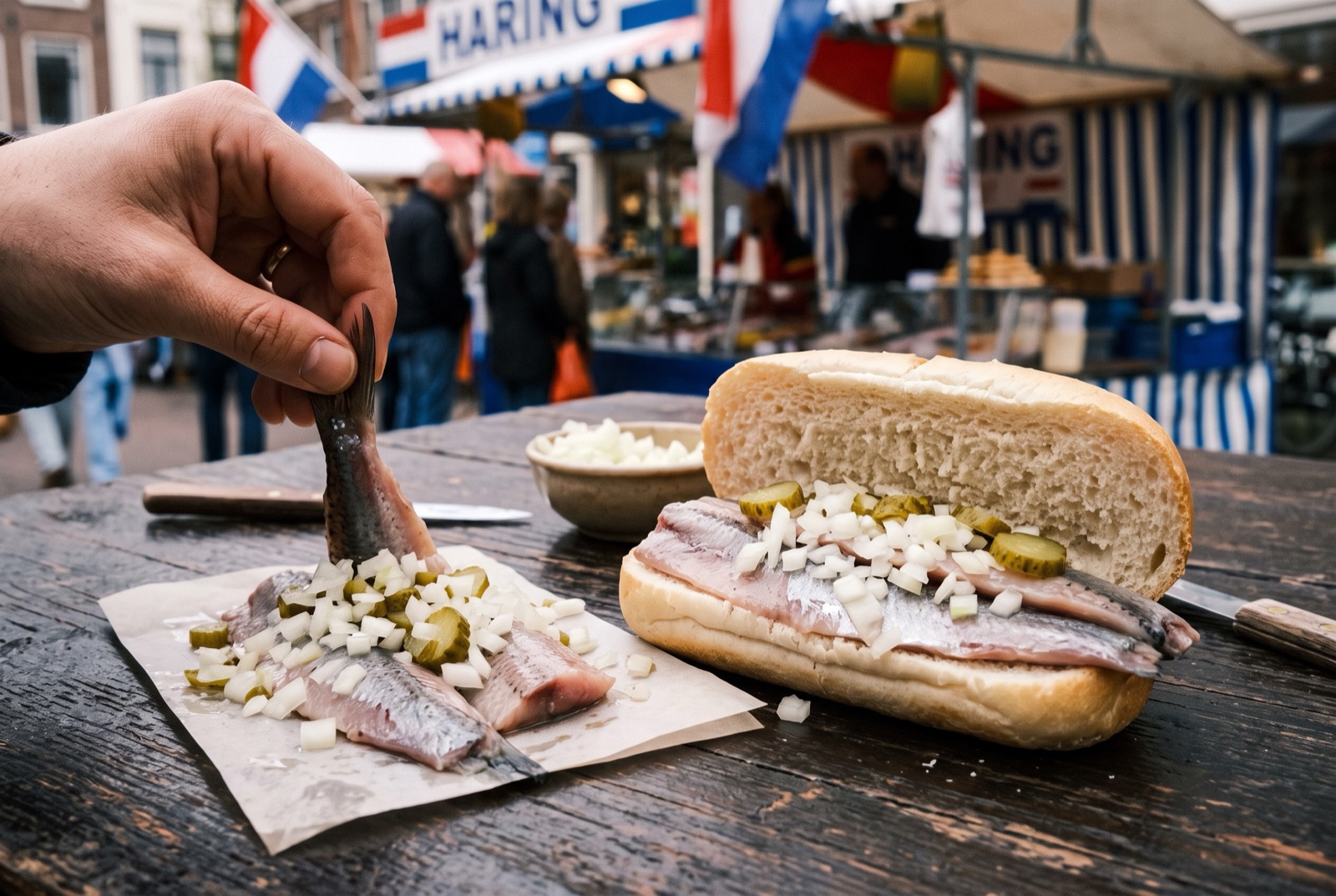
Hollandse Nieuwe is young North Sea herring, gutted in a way that leaves the pancreas in place so its enzymes ripen the flesh, then cured in light brine for a few days. The result is nothing like a salty pickled herring: it is soft, faintly sweet, almost buttery, with a clean sea flavour and no sharpness at all. It is served with a mound of finely chopped raw onion and sliced pickle, either on a paper tray with a small flag as a fork or, at the fish stall, held by the tail and lowered into your mouth. There is no cooking here — the skill is in buying the right fish, cutting the onion small enough, and getting the balance of fish to onion right.

- Gate
- NetherlandsNorth and South Holland
- Prep
- 20 min
- Cook
- 5 min
- Total time
- 48 hr 25 min incl. 48 hr rest
- Serves
- 4
- Status
- Easy
- Nutrition / serving · estimated
- Calories 310 kcal
- Protein 24 g
- Carbs 8 g
- Fat 20 g
- Fiber 1 g
- Sodium 1450 mg
Why this recipe works.
- Tells you what to actually buy and how to judge quality, which matters more here than any technique.
- Includes a short home brine-cure for fresh fillets, for anyone outside the Netherlands who cannot get the real thing.
- Handles food safety honestly: herring eaten raw must be frozen first, and this explains exactly why.
- Covers both the street-stall way and the broodje haring, so you can eat it the way you prefer.
Ingredients.
12 itemsTo serve
For the home cure
Equipment
- Sharp knife
- Small saucepan for the brine
- Non-metallic dish for curing
Instructions.
If curing at home, freeze first
Freeze the fresh herring fillets solid at minus 20°C for a full 24 hours before doing anything else, then thaw them overnight in the fridge. This kills parasites and is not negotiable for fish that will be eaten uncooked.
Make the brine
Bring the water, salt, sugar, bay and peppercorns to a simmer, stir until the salt has completely dissolved, then take it off the heat and add the vinegar. Cool the brine to fridge-cold before it touches the fish.
Tip Warm brine starts to cook the surface of the fillets and gives a chalky, opaque edge.
Cure the fillets
Lay the thawed fillets skin-side down in a non-metallic dish, pour over the cold brine and refrigerate for 24 hours. They are ready when the flesh has turned from translucent to pale and silky and holds together when lifted by one end.
Prepare the onion
Chop the onions as finely as you can manage, then soak the dice in cold water for 10 minutes and drain thoroughly on a towel. This takes the harsh edge off without losing the crunch you want against the soft fish.
Bring the herring to temperature
Take the fillets out of the fridge 10 minutes before serving and pat them dry. Straight from the fridge the fat is firm and the flavour is muted; slightly cool is where it tastes best.
Serve the stall way
Lay two fillets per person on a plate, heap the chopped onion beside or over them and add a fan of pickle slices. Eat with a fork, or pick a fillet up by its tail end and lower it in, which is how it is done at the cart.
Or make a broodje haring
Split the rolls, butter them lightly, lay in a fillet cut in two, then pack in the onion and pickle and press the roll shut. Eat immediately, over a napkin — this is a messy sandwich by design.
Tips from our kitchen.
- Chop the onion very fine — 2–3 mm dice. Coarse onion overwhelms the fish and turns each bite into a raw onion sandwich.
- Soak the chopped onion in cold water for 10 minutes and drain well if it is aggressive. This removes the harshest sulphur compounds without killing the crunch.
- Serve the herring cold but not fridge-cold. Ten minutes out of the fridge lets the fat soften and the flavour open up.
- Buy herring that looks translucent and glossy, not chalky or grey at the edges. Dull, matte fillets have been sitting too long.
- If your herring came in a strong salty brine, rinse briefly and pat dry; over-salted fish flattens everything else on the plate.
- Eat it the day you open the pack. Cured herring loses its softness fast once exposed to air.
Substitutions.
- Hollandse Nieuwe herring → Matjes herring fillets (German or Scandinavian), sold chilled or in oil
- Matjes uses the same principle and is the closest widely available product. Rinse fillets packed in oil and pat dry before serving.
- Fresh herring for home curing → Frozen-then-thawed herring fillets, or fresh mackerel fillets
- Mackerel is fattier and stronger but takes a light salt cure well. Whatever you use must have been frozen solid first if you plan to eat it uncooked.
- Raw onion → Onion quickly pickled in vinegar and a pinch of sugar for 20 minutes
- Less traditional but gentler, and useful if raw onion disagrees with you. Drain it well so it does not water down the fish.
Variations.
- Broodje haring
- The whole thing folded into a soft white roll with the onion and pickle inside — the standard lunchtime version at Dutch fish stalls.
- Amsterdam style
- Fillets cut across into bite-sized pieces, served on a paper tray with a heap of onion and a small flag to spear them with.
- Haring with pickled beetroot
- Diced pickled beetroot alongside the onion, which is common in the north and adds sweetness and colour against the pale fish.
Storage & reheating.
Cured herring is best on the day it is opened and should be eaten within 2 days, kept covered in the fridge on a plate rather than in its packing liquid. Do not freeze it after curing — the flesh is already soft, and a freeze-thaw cycle turns it mushy and weeping. Chopped onion keeps a day in a sealed container but starts to smell strongly; chop it fresh if you can. The home cure below should be eaten within 3 days.
Serve with
Cold jenever or a pilsner, and a plate of pickled gherkins and silverskin onions.
The story behind Hollandse Nieuwe.
Herring made the Netherlands rich. From the fourteenth century the Dutch herring fleet worked the North Sea and salted the catch at sea in barrels, which meant it could travel and be traded across Europe — an industry substantial enough that historians treat it as one of the foundations of Dutch commercial power. The technique behind it, called gibbing, is credited by tradition to Willem Beukelszoon of Biervliet, though the practice was almost certainly developed gradually rather than invented by one man. What gibbing does is remove the gills and most of the guts while deliberately leaving the pancreas, whose enzymes then ripen the flesh during salting into something soft and mellow rather than merely preserved.
The Hollandse Nieuwe season is real and closely watched. Herring caught before spawning, when their fat content is above roughly 16 percent, are the ones that qualify; the fishery opens in late spring, and the first barrel is auctioned for charity at Vlaardingen or Scheveningen each June in an event called Vlaggetjesdag, flag day, with prices that bear no relation to what the fish is worth. For a few weeks afterwards the stalls advertise nieuwe haring and Dutch people buy it with a seriousness usually reserved for the first asparagus.
The onion is not a garnish, and its origins are practical: in the days when the cure was much saltier, chopped onion and pickle cut the salt. Modern herring is mild enough that the onion is now about texture and bite, but it stayed. How you eat it is regional — in Amsterdam the fillets are usually cut into pieces and served on a tray with onion and a cocktail flag, in Rotterdam and The Hague you are more likely to be handed a whole fish by the tail and expected to tip your head back. Both camps consider the other slightly odd.
Questions, answered.
Is Dutch herring raw?
Technically it is cured rather than cooked, so yes, it is uncooked. It is gutted in a way that leaves the pancreas in place, whose enzymes ripen the flesh during a few days in light brine — a process closer to a very short fermentation than to pickling. That is why it tastes soft and mild rather than sharply salty, and why texture matters so much when judging quality.
Is it safe to eat, and does it need freezing?
Commercially sold Hollandse Nieuwe is legally required in the Netherlands to be frozen to around minus 45°C briefly, or minus 20°C for at least 24 hours, to kill Anisakis parasites — so what you buy is already safe. If you are curing fresh herring at home, you must freeze it solid at minus 20°C for at least 24 hours first. This is not optional, and no salt cure substitutes for it.
What does Hollandse Nieuwe actually taste like?
Mild, soft and faintly sweet, with a clean sea flavour and a texture closer to good sashimi than to pickled fish. People who dislike jarred pickled herring in vinegar are often surprised, because the two products have very little in common. It is fatty in a pleasant way, which is why the raw onion and pickle are served alongside to cut through it.
Do I have to eat it by the tail?
No, and plenty of Dutch people do not. The tail-first method is associated with Rotterdam and The Hague; in Amsterdam the fillets are usually cut into pieces and eaten with a small flag or fork. The most common way of all is the broodje haring, folded into a soft white roll. Any of these is normal, and nobody at the stall will be impressed either way.
When is herring season?
Hollandse Nieuwe traditionally arrives in late spring or early June, when the herring are fat before spawning and their fat content is high enough to qualify. The first barrel is auctioned for charity, and the fish is at its best for a few weeks after that. Frozen stock is sold year-round and is genuinely good, but the seasonal fuss in the Netherlands is about the fresh catch.
You might also like.
All recipes →
Keep exploring Netherlands.
Netherlands has 9 more dishes in the atlas — Bitterballen and Draadjesvlees, and 7 more.
All Netherlands recipes Onion recipes Cucumber recipes Vinegar recipes appetizersnackstreet foodpescatarianRecipe by The DishRoute Kitchen · published August 19, 2026 · updated August 19, 2026