Suan La Tang.
Chinese Hot and Sour Soup
酸辣汤 · Suān là tāng · say it: swan-lah-TAHNG
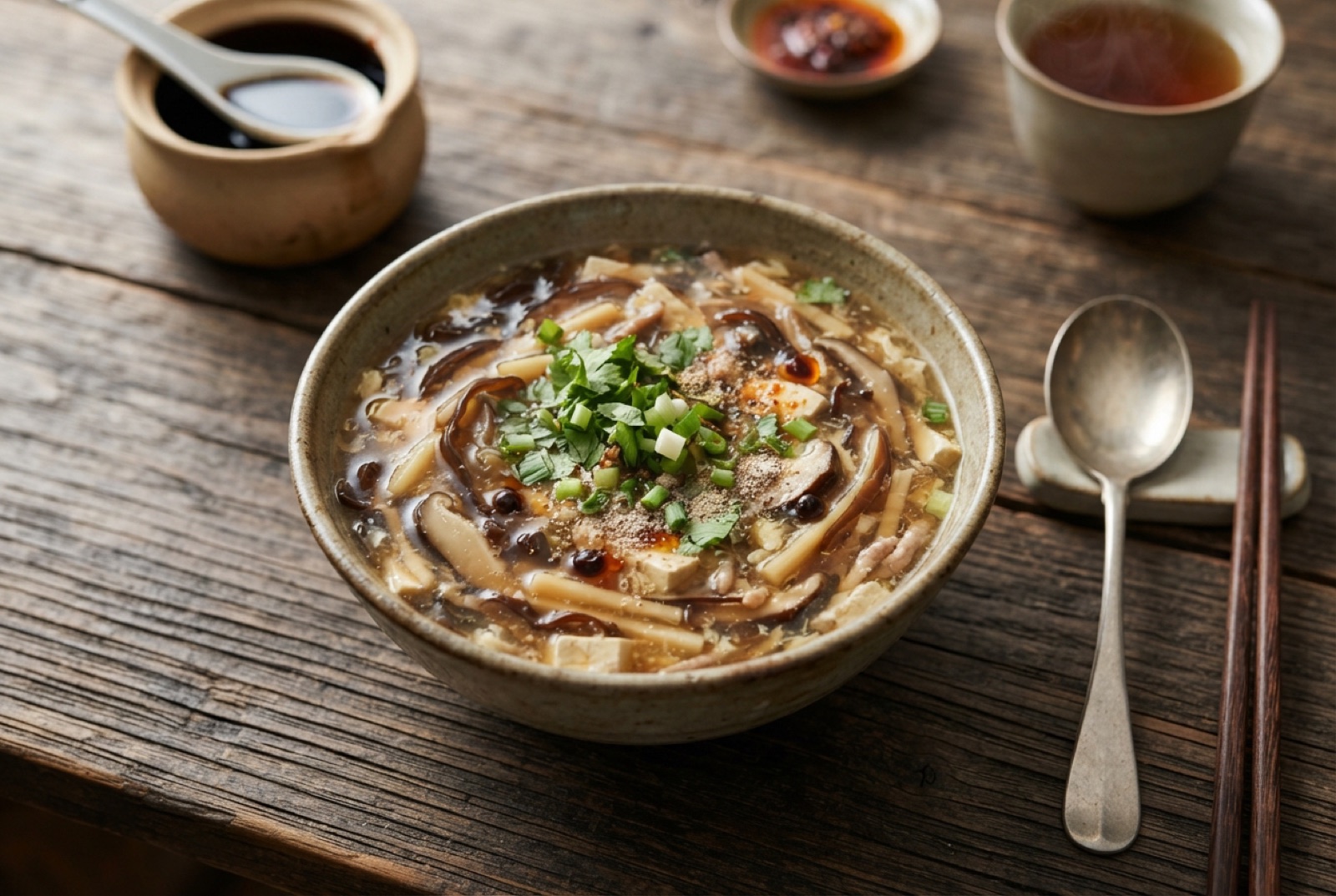
Hot and sour soup is a lightly thickened broth loaded with shredded wood ear fungus, bamboo shoot, shiitake and tofu, seasoned so the sourness of black vinegar and the dry heat of white pepper hit in that order, with egg drawn through in ribbons at the end. The texture is as much the point as the flavor: slippery fungus, springy bamboo, soft tofu and the faint body that cornstarch gives the broth, all in one spoonful. Crucially, the "hot" is pepper heat, not chili heat — it builds at the back of the throat and fades — which is why the soup tastes warming rather than fiery. It is a fast weeknight bowl built almost entirely from dried and jarred pantry ingredients.

- Gate
- ChinaNorthern China & Sichuan
- Prep
- 20 min
- Cook
- 20 min
- Total time
- 40 min
- Serves
- 4
- Status
- Easy
- Nutrition / serving · estimated
- Calories 210 kcal
- Protein 16 g
- Carbs 16 g
- Fat 9 g
- Fiber 3 g
- Sodium 1250 mg
Why this recipe works.
- Uses white pepper as the source of heat, which is what makes the soup taste like suan la tang rather than a generic chili broth.
- Adds the vinegar in two stages, with the last spoonful off the heat, so the sourness stays bright instead of simmering flat.
- Thickens the broth to coat a spoon and no further, avoiding the gluey takeaway texture most people know.
- Built from dried mushrooms, wood ear and jarred bamboo, so it can be made from the cupboard at short notice.
Ingredients.
15 itemsTo soak
For the soup
To season
To finish
Equipment
- Medium saucepan or small pot
- Fine sieve or cloth for straining the soaking liquid
- Whisk
Instructions.
Soak the dried goods
Cover the wood ear and shiitake with warm water and leave 20 minutes, until the wood ear has swelled several times over and feels rubbery-soft and the mushroom caps are pliable. Strain and keep the soaking liquid.
Shred everything to match
Trim any hard knots from the wood ear and cut it into thin strips, slice the shiitake caps finely, and cut the bamboo, tofu and pork the same size. Uniform matchsticks are what let one spoonful pick up a bit of each.
Build the broth
Bring the stock and the strained soaking liquid to a simmer, add the pork strips and stir to separate them, then add the wood ear, shiitake and bamboo. Simmer 5 minutes, until the pork is opaque and the broth smells mushroomy.
Season boldly
Stir in both soy sauces, the ginger, the white pepper and half the black vinegar. Slide in the tofu and simmer 2 minutes more, moving it gently so the matchsticks stay whole.
Tip It should taste slightly too strong at this stage — the starch and egg to come will mute it.
Thicken to a coating
Stir the cornstarch slurry again, then pour it into the simmering soup in a thin stream while stirring. Cook for 1 minute, until the broth turns glossy and just coats the back of a spoon — stop well before it looks like gravy.
Draw in the egg
Turn the heat to its lowest setting so the surface barely trembles, then drizzle the beaten eggs in a thin stream over the back of a spoon, moving across the pot. Wait 10 seconds for the ribbons to set before stirring once.
Finish off the heat
Take the pot off the stove and stir in the remaining black vinegar and the sesame oil, then taste and push the vinegar and white pepper up together until the soup lands sharp and warming. Ladle into bowls and scatter with scallions.
Tips from our kitchen.
- Soak dried wood ear in warm water for 20 minutes and expect it to swell to five or six times its dry volume — a small handful is plenty for four bowls.
- Strain the mushroom soaking water through a cloth and add it to the stock. It carries most of the dried shiitake flavor and throwing it out is a real loss.
- Grind white pepper fresh if you can. Pre-ground white pepper goes dusty and stale quickly, and this soup depends on it almost as much as on the vinegar.
- Drizzle the beaten egg in a thin stream over the back of a spoon while the soup barely moves, then wait ten seconds before stirring, or you will get cloudy broth instead of ribbons.
- Add the final tablespoon of vinegar after the pot is off the heat. Boiled vinegar tastes dull and flat, and the difference is immediately obvious side by side.
- Taste at the end and adjust vinegar and pepper together, not one at a time — they balance each other and the soup should land sharp, savory and warming.
Substitutions.
- Dried wood ear fungus → Extra shiitake plus a handful of enoki mushrooms
- Nothing quite reproduces wood ear's crunchy-slippery texture, which is the reason it is there. It is cheap in Asian shops, keeps for years dry, and is worth seeking out.
- Zhenjiang black vinegar → Rice vinegar with a splash of balsamic
- Black vinegar is malty and rounded rather than sharply acidic. Straight white vinegar makes the soup thin and harsh, so cut it with a little sugar if it is all you have.
- Pork loin strips → Chicken breast strips, or leave the meat out entirely
- The soup is frequently made vegetarian in China; use a good mushroom stock and add a spoonful of soy sauce for depth if you skip the meat.
Variations.
- Vegetarian suan la tang
- Omit the pork, use vegetable or mushroom stock, and add extra tofu and bamboo. With the shiitake soaking liquid in the pot it loses very little savoriness.
- With day lily buds
- Soak a handful of dried golden needles (day lily buds) with the mushrooms and add them with the vegetables. They bring a faintly floral, tea-like note and are traditional in banquet versions.
- Sichuan chili finish
- Stir a teaspoon of chili oil into each bowl at the table for chili heat on top of the pepper heat. A common Sichuan restaurant touch, but keep the white pepper — it is not a replacement.
Storage & reheating.
Keeps 3 days refrigerated, though the cornstarch loosens as it sits and the egg ribbons soften. Reheat gently without boiling, then refresh with a teaspoon of black vinegar and a fresh grind of white pepper — both fade in the fridge and the soup tastes dull without them. Do not freeze: the tofu turns spongy and the thickened broth separates into water and starch on thawing.
Serve with
Steamed rice or a plate of pan-fried dumplings; in northern China this soup often turns up alongside jiaozi rather than before a main course.
The story behind Suan La Tang.
Hot and sour soup is claimed by more than one region, and the honest answer is that nobody settles it. Versions are strongly associated with Sichuan, where suan la tang usually leans on white pepper and vinegar and is served after a heavy meal, and with the north around Beijing and Henan, where thicker, darker bowls turn up as hu la tang, a peppery breakfast soup of an entirely different character. What the versions share is the pairing that gives the soup its name: sour from vinegar, hot from ground pepper, both added late so neither cooks off.
The combination is not arbitrary. Chinese food thinking treats sour and pungent as appetite-opening and warming, which is why this soup shows up in cold weather, at the end of banquets to cut through fat, and in the folk pharmacy as something to drink when a cold is coming on. The classic vegetable line-up — wood ear, day lily buds, bamboo shoot, dried shiitake — is a dried-goods roster, meaning a cook could make it in any season from what hung in the pantry, and the reconstituting liquid goes back into the pot as free stock.
Outside China the soup became a takeaway fixture and, in the process, often lost its way: cornstarch heavy enough to stand a spoon in, sweetness that has no business there, red chili oil floated on top for looks, and no wood ear at all. The version below stays close to the restaurant standard in China — thickened just enough to coat a spoon, sharp with Zhenjiang black vinegar, aggressively peppered, with a final splash of vinegar off the heat because vinegar loses its edge the moment it boils.
Questions, answered.
Why is my hot and sour soup not sour enough?
Almost always because the vinegar was added too early and boiled. Acetic acid is volatile, so simmering drives it off and leaves a flat, savory broth. Add half the vinegar during cooking for depth and the rest after the pot leaves the heat, then taste and adjust.
Where does the heat in hot and sour soup come from?
From ground white pepper, not chili. White pepper gives a dry, throat-catching warmth that builds and fades quickly, which is exactly the sensation the dish is built around. Chili oil is sometimes added at the table in Sichuan, but a soup made with chili instead of pepper tastes like something else.
Can I make it without cornstarch?
You can, and you will get a clear, brothy soup that tastes right but feels thin — the light body is part of the dish's identity. If you avoid cornstarch, potato starch or arrowroot both work; use slightly less arrowroot and add it off a hard boil, as it thins if overcooked.
What is wood ear and do I have to use it?
Wood ear is a dark, thin, ear-shaped fungus sold dried; soaked, it becomes slippery on the surface and crunchy at the edge, and it contributes texture rather than strong flavor. You can leave it out and use more mushrooms, but the characteristic bite of the soup goes with it.
How do I get proper egg ribbons instead of scrambled clumps?
Turn the heat to low so the surface barely moves, beat the eggs until completely smooth, and pour them in a thin stream over the back of a spoon while moving it across the pot. Let them set for about ten seconds untouched, then stir once. Pouring fast into a rolling boil is what produces clumps.
You might also like.
All recipes →
Keep exploring China.
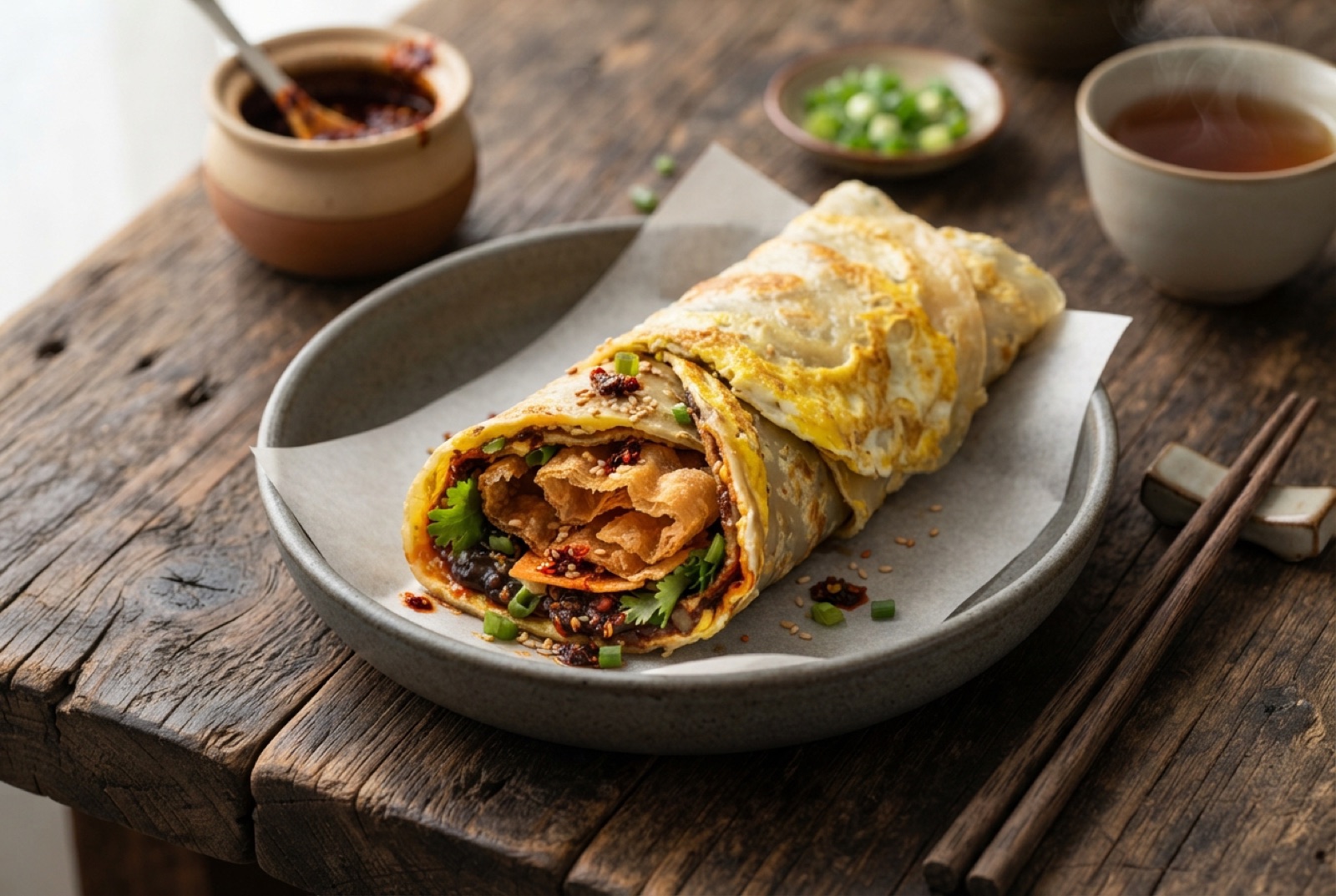
China has 9 more dishes in the atlas — Char Siu and Cong You Bing, and 7 more.
Recipe by The DishRoute Kitchen · published August 19, 2026 · updated August 19, 2026